
When people think of lung cancer, smoking often comes to mind. However, few realize that the second leading cause of lung cancer in the United States is an invisible, odorless threat rising from beneath our homes — radon gas. November is Lung Cancer Awareness Month, and it’s the perfect time to talk about radon testing and radon mitigation.
Radon is a naturally occurring, radioactive gas produced through the radioactive decay of uranium in the soil, rock, and water beneath your home. As it seeps upward, radon can enter through cracks in your foundation, crawl space, basement floor, or even small openings around pipes and ducts. Once inside, it mixes with the air you breathe — compromising your indoor air quality and your health.
Why Radon Is a Serious Environmental Health Concern
According to the Environmental Protection Agency (EPA), radon is the second leading cause of lung cancer overall and the leading cause among non-smokers. The EPA estimates that radon exposure is responsible for more than 20,000 lung cancer deaths each year in the U.S.
The statistics are especially alarming for residents of the Rocky Mountain region, where radon levels tend to be higher due to our unique soil composition, climate, and construction practices. In some homes, breathing the indoor air can expose you to radiation equivalent to smoking a pack of cigarettes per day.
Whether you live in a newly built house that meets modern building codes or an older home with a deeper basement, radon can be present anywhere. Homes with sumps, crawl spaces, or poorly sealed floors and attics are particularly susceptible because radon moves through soil gas and small foundation cracks with ease.
The Science Behind Radon Entry and Accumulation
Radon gas moves through the soil and enters homes through tiny openings in the foundation, pump drains, and floor joints. Because it’s heavier than air, it tends to accumulate in lower areas such as basements and crawl spaces. Once indoors, it can travel through your duct system, circulate through your air conditioning or condenser unit, and spread throughout the entire home.
Even homes with air-tight construction or energy-efficient designs can trap radon and other particulates, further reducing air exchange. Without proper ventilation or a radon mitigation system, these levels can rise well above the EPA’s action threshold of 4.0 pCi/L (picocuries per liter).
How Radon Mitigation and Reduction Systems Work
The good news? Radon reduction is simple, affordable, and highly effective when done professionally.
A radon mitigation system works by drawing the soil gas from beneath your home’s foundation or slab floor and venting it safely outdoors. This is typically achieved using a vent pipe, sump pump connection, and a specialized fan system that creates negative pressure beneath your home. The gas is then released above the roofline, where it quickly disperses harmlessly into the atmosphere.
These radon reduction systems are long-lasting and can reduce radon levels by up to 95% or more. Many systems also integrate with existing HVAC, air filter, or ventilation systems, improving your overall indoor air quality while protecting your family’s health.
Professionally installed mitigation systems are designed to comply with EPA and state building code standards, ensuring both efficiency and safety.
Why Radon Testing Is Essential
The only way to know if your home has high radon levels is through proper radon measurement. Testing is simple and inexpensive — a small investment that could save your life. If your test results come back high, professional radon mitigation should be your next step.
Whether your home has a basement, crawl space, or slab-on-grade foundation, a customized radon system can be installed to match your home’s unique structure and air pathways.
Protect Your Family’s Health This November
This November, during Lung Cancer Awareness Month, take action to protect your family’s long-term health. Radon exposure is entirely preventable with professional testing and mitigation. Don’t let your home become a silent contributor to lung cancer risk — take control of your environmental health today.
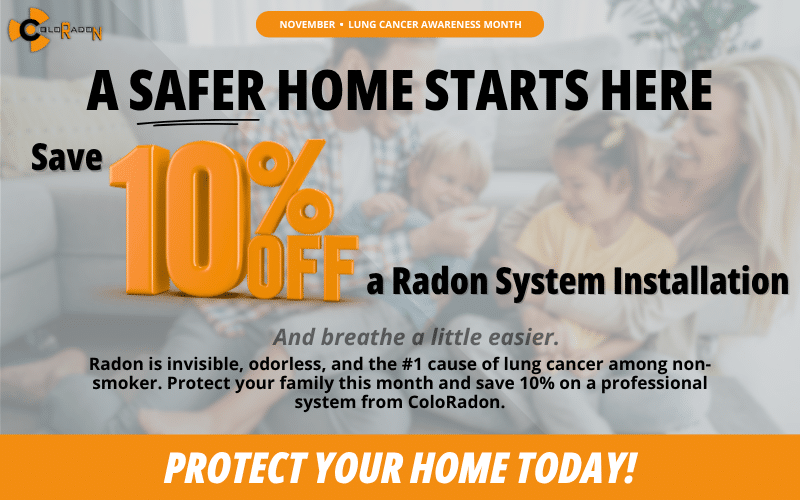
At ColoRadon LLC, we’re committed to keeping your indoor air safe and clean. In honor of November’s awareness campaign, we’re offering 10% off radon testing to help more families breathe easier and live healthier.
Contact us today to schedule your radon test, learn more about mitigation systems, or speak with a licensed radon professional about how we can improve your indoor air quality.
Protect what matters most — because a healthy home begins with the air you breathe.